
You know the moment: you open a map of a dream destination and suddenly every pin looks essential. The fairytale castle, the hidden beach, the famous market, the museum everyone swears is life-changing. Next thing you know, you have 27 “must-dos” and exactly three days.

A great itinerary is not a checklist. It is a pacing plan that protects the magic – and your energy – while still getting you to the experiences that made you book the trip in the first place. Here is how to plan a trip itinerary that feels adventurous and achievable, whether you are traveling solo, as a couple, or with the whole family.
Start with the trip’s “why,” not the map
Before you plot a single attraction, get clear on what you want this trip to feel like. Two people can visit the same city and have completely different best trips – one is chasing food stalls and street photography, the other wants museums and long café afternoons.

Pick one primary focus (food, nature, romance, theme parks, culture, shopping, wellness, nightlife) and one secondary focus. This keeps your days cohesive and makes decisions easier when everything looks tempting.
It also helps to name your pace: “slow and scenic,” “balanced,” or “maximizer.” There is no wrong answer, but there are trade-offs. A maximizer itinerary creates more highlights and more fatigue. A slow itinerary creates more breathing room and fewer big-ticket sights. Balanced is usually the sweet spot for first-time visitors.
Lock your non-negotiables first
Some parts of a trip are time-sensitive. Build your itinerary around those anchors before you fill in anything else.
Start with fixed items like flights, hotel check-in and check-out times, and any events with strict entry times. Then add the experiences that can sell out or that you truly do not want to miss, like a Broadway show, a whale watching tour, a popular cooking class, or a limited-entry museum.
If you are traveling during peak season or holidays, this step matters even more. You can still keep your days flexible, but your anchors should be real reservations, not hopeful ideas.
Choose your home base strategy: one stay or a split

This is where itineraries either feel smooth or feel like a suitcase relay.
If your destination has a strong central hub (like Rome, Tokyo, or New York City), one home base often makes the trip easier. You unpack once, learn the neighborhood, and you are not constantly re-learning transit.
A split stay is worth it when travel times are long or when you are combining very different experiences, like city plus beach, or mountains plus a major capital. The trade-off is that moving days eat time. A good rule: if changing hotels costs you more than half a day of usable exploring, do it only if the second location meaningfully upgrades the experience.
Build a simple skeleton for each day
Once you have anchors and a base plan, stop thinking in hour-by-hour detail. Think in blocks. Most travelers do best with three blocks: morning, afternoon, and evening.
Here is a realistic approach that prevents overstuffing:
Give each day one “main character” experience
Pick one primary activity per day that sets the tone. Maybe it is a national park hike, a famous museum, a day trip, or a beach day with a sunset cruise. This is the experience you protect when weather shifts or plans change.
Then add one to two supporting activities that are nearby and easier to drop if time gets tight.
Respect your energy curve
Most people have their best energy earlier in the day. Put the most important sight or the most complex logistics in the morning. Save flexible wandering, shopping, and casual meals for later.
If you are traveling with kids, build around snack breaks and playground stops. If you are traveling as a couple, plan your “wow” moments when you are not hungry and tired. If you are solo, remember that decision fatigue is real – leave room for spontaneous choices without pressure.
Design the evening on purpose

Evenings can be magical or messy. Decide what you want them to be.
If nightlife is part of your “why,” group evening experiences in a walkable area and keep the next morning lighter. If you are a sunrise person, make evenings easy: a great dinner close to your hotel and one short, beautiful walk.
Use geography to cut transit time in half
The fastest way to ruin a day is bouncing across town three times. Group activities by neighborhood or by side of the city.
Do a quick map sweep and cluster your pins into 2-4 zones. Then assign zones to days. This reduces the “how do we get there?” friction and leaves more time for the fun stuff.
This matters even more in spread-out destinations like Los Angeles, Orlando, or larger European capitals where crossing town can take longer than you expect.
Plan for real-world timing (not best-case timing)
Most itinerary stress comes from optimistic math.
Add time for the parts people forget: getting ready, grabbing water, waiting for rideshares, finding the right entrance, security lines, bathroom breaks, and the slow-down that happens when you are dazzled and want to linger.
A practical pacing guideline:
- For a major museum or theme park, plan at least 3-5 hours.
- For an iconic viewpoint or landmark, plan 60-90 minutes including photos and getting there.
- For meals, plan 60-90 minutes for sit-down and 30-45 minutes for quick bites (more if it is a famous spot with lines).
And if you are switching cities by train or flight, that is not “just two hours.” Door-to-door, it is often half a day once you add checkout, getting to the station or airport, waiting, and getting settled again.
Keep one “float” window every day
If you want an itinerary that actually works on the road, build in a buffer. Think of it as your magic window: time for a surprise market, a longer lunch, a street performance, or simply a nap.
For maximizer travelers, the float window is what prevents you from feeling like you failed when one thing runs late. For slow travelers, it is what makes the trip feel luxuriously unhurried.
A simple approach is to leave either mid-afternoon or post-lunch open. That is when energy dips and when delays tend to stack.
Decide your booking threshold: what to reserve vs. what to wing

Some travelers love spontaneity. Others sleep better with confirmations in hand. The right answer depends on your season, your destination, and your personality.
Reserve in advance when the activity is capacity-limited or when missing it would genuinely disappoint you. Wing it when the experience is plentiful (like casual restaurants), when weather is unpredictable (like certain outdoor activities), or when you are still learning the vibe of the city.
If you are nervous about over-committing, try this ratio: reserve one key experience per day, then keep the rest flexible.
Build two backups: a “rain plan” and a “low-energy plan”
This is the itinerary upgrade most people skip, and it is the reason some trips feel effortlessly smooth.
Your rain plan is not “stay inside.” It is a list of indoor wins: a market hall, a museum, an aquarium, a food tour, a spa session, a cooking class, or a great neighborhood for café-hopping.
Your low-energy plan is for the day you are tired but still want something memorable. Think scenic drives, a boat ride, a shorter viewpoint hike, a beach afternoon, or a hop-on hop-off style loop.
When you build these in advance, you stop negotiating with yourself in the moment.
Make your itinerary shareable with your future self
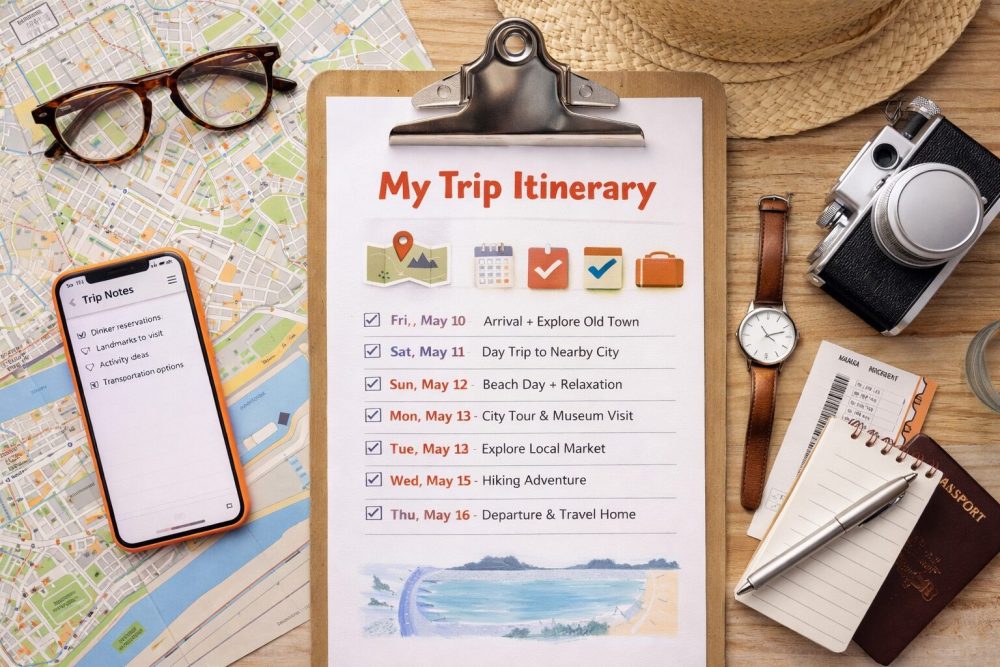
A working itinerary is easy to read on a phone and easy to follow when you are hungry, jet-lagged, and standing on a busy street.
Keep it simple:
Write each day with your anchor first, then 2-3 supporting ideas nearby. Add addresses or neighborhood names, and note any reservation times. If you like detail, add one sentence per stop on what it is and why it is worth it. You do not need a novel.
If you are traveling with others, share the plan early and ask one direct question: “What is the one thing you would be sad to miss?” That single prompt prevents a lot of conflict later.
For destination-specific itinerary ideas you can adapt, you can pull inspiration from guides on TravelInnTour.com and then tailor the pace to your own travel style.
Common itinerary mistakes (and the easy fixes)
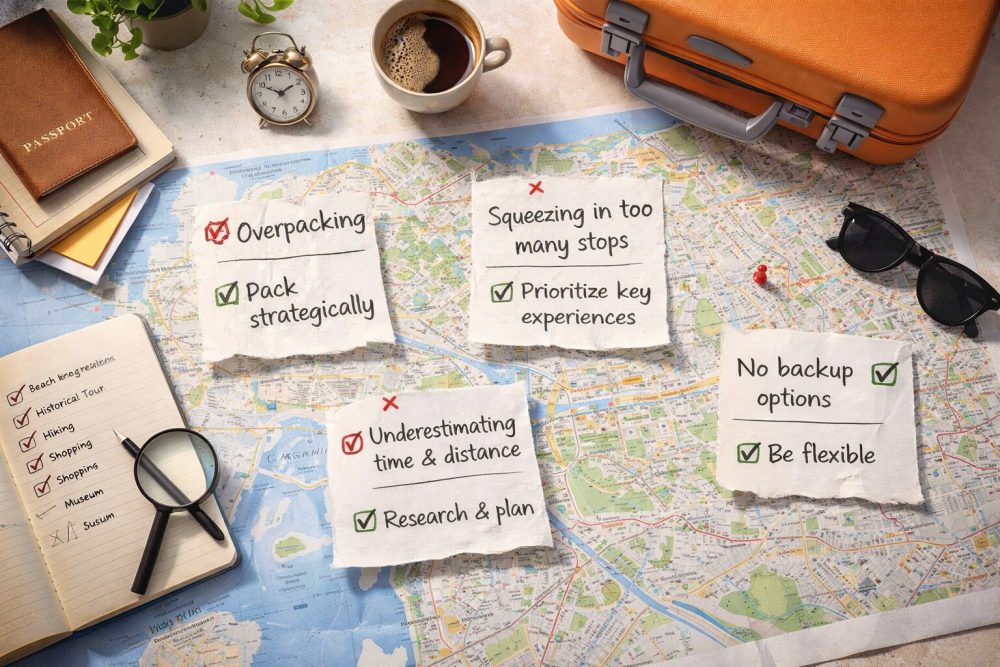
Overplanning usually comes from a good place – excitement. But a few patterns almost always create stress.
Trying to see two far-apart neighborhoods in the same morning is a classic. Fix it by choosing one zone per block of the day.
Skipping meal planning can also backfire. You do not need reservations for every meal, but you do need a plan for the “hangry hour.” Pick one reliable lunch area and one reliable dinner area near where you will already be.
Finally, leaving no room for the unplanned moments is the quiet itinerary killer. Those unplanned moments are often the stories you tell later.
Plan like a pro, but leave space for wonder. When your itinerary has a clear purpose, realistic timing, and a little breathing room, the trip stops feeling like a race and starts feeling like the version of travel you actually wanted all along.
Share it On Pinterest






Leave a Comment